

English patient page

Refractive Surgery in São Paulo

Laser vision correction for myopia, astigmatism and hyperopia

Refractive surgery is a family of procedures designed to reduce dependence on glasses and contact lenses. At Ortolan Oftalmologia in São Paulo, English-speaking patients are evaluated by a USP-trained ophthalmology team using corneal tomography, retinal mapping, dry-eye screening and individualized surgical planning before LASIK, PRK, SMILE or phakic IOL options are discussed.

Common reasons patients seek refractive surgery

Myopia icon
MYOPIA
Difficulty seeing far away
Astigmatism icon
ASTIGMATISM
Blurred or distorted vision at multiple distances
Hyperopia icon
HYPEROPIA
Difficulty focusing up close, and sometimes far away
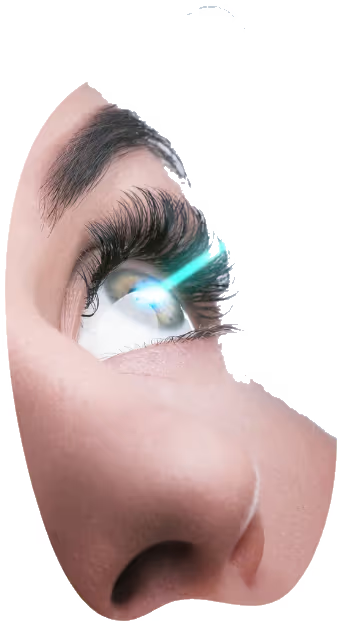
Patient enjoying visual freedom after refractive surgery.
Why the evaluation matters

Not every eye should be operated the same way.

The best refractive outcome starts with the right indication. At Ortolan, the consultation is designed to decide whether laser surgery is safe, whether phakic IOLs should be considered, and what recovery timeline fits the patient's travel plans.

Compare with phakic IOLs
Active lifestyle after reducing dependence on glasses.

Presbyopia options: PRESBYOND and READ

Presbyopia is the age-related loss of near focusing ability, usually noticed after the early 40s. It is different from myopia, hyperopia or astigmatism: the natural lens gradually loses flexibility, so reading and phone distance become harder even when distance vision is good.

Some presbyopic patients can be considered for corneal laser strategies that increase depth of focus, often combined with a small intentional difference between the two eyes. These approaches try to reduce dependence on reading glasses, but they involve visual trade-offs and require careful simulation and counseling.

PRESBYOND Laser Blended Vision is a ZEISS software-based LASIK strategy for presbyopia, planned around binocular vision, micro-anisometropia and customized depth of focus.

READ (Refractive-Enhanced Aspheric Design) is the approach described by Dr. Damien Gatinel for selected presbyopic hyperopic and emmetropic patients. It is implemented in the Alcon WaveLight EX500 excimer laser software; when performed as FemtoLASIK, the corneal flap can be created with the WaveLight FS200 femtosecond laser.

Neither option is a universal fix for presbyopia. Patient age, dominant eye, distance prescription, pupil size, ocular surface, lens status, night-driving needs and tolerance for blended vision all change the recommendation.

How refractive surgery works

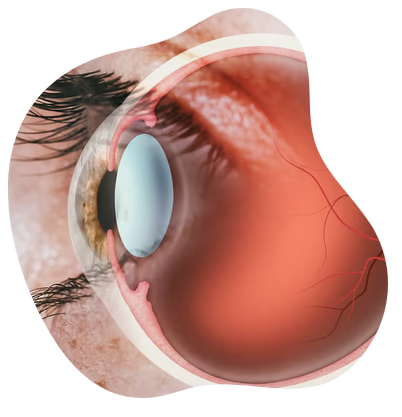
Laser refractive surgery reshapes the cornea with micrometric precision so that light focuses more accurately on the retina. The goal is to reduce, and in many cases eliminate, dependence on glasses or contact lenses for daily life.

Laser planning depends on corneal shape, thickness and the patient's full eye exam.

The most common procedures are LASIK, FemtoLASIK, PRK and SMILE. For patients with high myopia, thin corneas or anatomy that makes laser surgery less suitable, phakic intraocular lenses may be a better option.

The surgery is usually performed with anesthetic eye drops, without hospitalization. The procedure itself is short, but the decision is never casual: the quality of the preoperative evaluation is what determines whether surgery is safe and which technique makes sense.

Who can be a candidate?

A typical candidate is over 18, has a stable prescription for at least one year, healthy eyes, adequate corneal thickness and curvature, and realistic expectations. Borderline cases require careful individualized analysis.

Illustration of eyes being evaluated for refractive surgery.
A good indication matters more than the brand name of the procedure.

Patients with signs of keratoconus, unstable refraction, active ocular surface disease, uncontrolled dry eye, certain autoimmune diseases or high-risk retinal findings may need treatment first, a different surgical plan, or a recommendation not to operate.

For patients over 40, near vision must be discussed separately. Conventional laser correction does not stop presbyopia, so reading glasses, monovision, blended-vision strategies or lens-based options may be considered depending on the case.

Preoperative screening at Ortolan

The preoperative workup evaluates the cornea, retina, optic nerve, tear film, prescription stability and medical history. When possible, complementary exams are performed in the same appointment.

Eye evaluation before refractive surgery.
Corneal tomography, ocular surface evaluation and retinal assessment guide the surgical plan.
  • Corneal topography and tomography to study shape, thickness and keratoconus risk.
  • Refraction and visual acuity testing to confirm the prescription and visual potential.
  • Dry-eye and ocular surface evaluation, because untreated dry eye can affect comfort and results.
  • Retinal mapping and optic nerve evaluation to identify findings that may change the surgical plan.
  • Lifestyle and occupational review, including sports, screen work, travel timeline and visual goals.

This screening is especially important for international patients, because the safest plan may require a staged approach, additional testing, or postponing surgery until the ocular surface is optimized.

Contato rápido

Considering refractive surgery in São Paulo?

Send a message in English and our team can help align consultation, exams and surgery timing.

Schedule in English

Main techniques: LASIK, PRK, SMILE and phakic IOLs

LASIK / FemtoLASIK: a thin corneal flap is created, the excimer laser corrects the prescription underneath, and the flap is repositioned. Visual recovery is usually fast.

Illustration of refractive surgery techniques.
Technique selection depends on anatomy, prescription, age and visual goals.

PRK: the surface epithelium is removed and the excimer laser treats the cornea without creating a flap. PRK can be useful for selected patients with thinner corneas or higher trauma exposure.

SMILE: a femtosecond laser creates a small lenticule inside the cornea, which is removed through a small incision. It may be discussed in selected myopia cases.

Phakic IOL / ICL: an implantable lens is placed inside the eye while the natural crystalline lens remains in place. It is often considered for high myopia or patients who are not ideal laser candidates. Learn more on our phakic IOL page.

Recovery and travel planning

Recovery varies by technique. LASIK and SMILE often have faster early visual recovery, while PRK usually has more discomfort and slower stabilization during the first days. Most patients need several postoperative visits.

Follow-up and correct use of drops are part of the procedure, not an afterthought.
  • Use all prescribed eye drops exactly as instructed.
  • Avoid rubbing the eyes, swimming pools and seawater during the early healing period.
  • Plan follow-up before returning home, especially if you are travelling internationally.
  • Report severe pain, marked redness or sudden vision loss urgently.

International patients should discuss the full timeline before scheduling surgery. The safest plan is to allow enough time in São Paulo for preoperative testing, the procedure and early postoperative checks.

Risks and honest counseling

Refractive surgery has a long track record and high patient satisfaction when well indicated, but it is still surgery. A serious consultation includes risks, limitations and alternatives.

Safety comes from correct indication, precise exams and careful follow-up.
  • Residual prescription may require glasses, contact lenses or a later enhancement in selected cases.
  • Dry eye is common in the first months and is usually temporary, but some patients need longer treatment.
  • Infection or inflammation is uncommon but must be treated quickly if warning symptoms appear.
  • Corneal haze or ectasia are rare but important risks, especially when screening is inadequate.
  • Presbyopia still progresses with age and may affect near vision after age 40.

The purpose of the evaluation is not to convince every patient to have surgery. It is to decide whether surgery is appropriate, which procedure is safest, and when another option is more responsible.

Medical team

USP-trained refractive surgery specialists

English-speaking care led by Dr. Lucca Ortolan Hansen, with cornea and refractive specialists for complex planning.

View profile
View profile
View profile
View profile
View profile
Related procedures

Main eye surgeries at Ortolan Oftalmologia

Refractive surgery, cataract surgery and phakic IOLs are planned after detailed diagnostic exams.

Contato rápido

Ready to plan the evaluation?

The team can help you understand whether an English-language refractive surgery evaluation is the right next step.

Message in English

Frequently asked questions

Can I have refractive surgery while visiting São Paulo?

Often yes, but timing matters. You should allow enough time for preoperative exams, surgery and early postoperative visits before returning home.

Is LASIK always better than PRK?

No. LASIK often has faster early recovery, but PRK can be safer or more appropriate for selected corneas, occupations or lifestyles.

What if I am not a laser candidate?

Some patients may be better candidates for phakic IOLs, specialty contact lenses, cataract/lens-based surgery later in life, or no surgery.

References

  1. U.S. Food and Drug Administration. What are the risks and how can I find the right doctor for me? FDA LASIK. Updated patient information. Source.
  2. National Eye Institute. Surgery for Refractive Errors. NEI. Updated patient information. Source.
  3. European Society of Cataract and Refractive Surgeons. Refractive Surgery. ESCRS Patient Portal. Patient information. Source.
  4. American Academy of Ophthalmology EyeWiki. Phakic Intraocular Lenses. EyeWiki. Reviewed 2026. Source.
  5. American Academy of Ophthalmology EyeWiki. Keratorefractive Lenticule Extraction (KLEx) Surgeries. EyeWiki. Reviewed 2024. Source.
  6. Gatinel D. Presbyopia & hyperopia correction using corneal asphericity (Q value) and multifocality: the READ approach. gatinel.com. Educational surgical technique note. Source.
  7. ZEISS Medical Technology. PRESBYOND Laser Blended Vision. ZEISS Meditec. Product and technique information. Source.
  8. Rahmania N, Salah I, Rampat R, Gatinel D. Clinical Effectiveness of Laser-Induced Increased Depth of Field for the Simultaneous Correction of Hyperopia and Presbyopia. Journal of Refractive Surgery. 2021;37(1):16-24. Source.
  9. Shen Z, Shi K, Yu Y, Yu X, Lin Y, Yao K. Small Incision Lenticule Extraction (SMILE) versus Femtosecond Laser-Assisted In Situ Keratomileusis (FS-LASIK) for Myopia: A Systematic Review and Meta-Analysis. PLoS One. 2016;11(7):e0158176. Source.
  10. Moshirfar M, Tukan AN, Bundogji N, Liu HY, McCabe SE, Ronquillo YC, et al. Ectasia After Corneal Refractive Surgery: A Systematic Review. Ophthalmology and Therapy. 2021;10(4):753-776. Source.
WhatsApp